

Why the cost of not transforming is often greater than the cost of transformation
The bucket under the leak
A small leak appears in the roof of a house.
The owner looks at the repair cost and decides to wait. A bucket is placed under the leak. It is cheaper, faster, and does not disturb anyone.
For a while, the decision appears reasonable. The bucket catches the water, the house remains open, and life continues as normal.
But the roof has not stopped leaking. Water is moving behind the walls. The ceiling is weakening. The wiring is becoming unsafe. What started as a small repair is slowly becoming a major renovation.
This is how many organizations approach transformation. They compare the visible cost of change with the apparent comfort of staying where they are. The transformation programme has a budget, a timeline, a team, and a list of risks. The current state appears to have none of these.
But staying where we are is not free.
The bucket has a cost too.

History provides many examples. One of the most fascinating is Xerox.
In 1970, Xerox created the Palo Alto Research Center, known as PARC, to develop the “Office of the Future.” Its researchers developed technologies that helped shape modern computing, including graphical user interfaces, Ethernet, laser printing, digital video, and word processing. Yet many PARC ideas did not become successful commercial products for Xerox.
The problem was not a shortage of innovation, talent, or technology. The harder challenge was finding the business model and the “architecture of the revenues” that could turn new technology into value. Research on Xerox’s technology ventures found that successful spin-offs went through significant business-model transformation, while failed ventures showed much less search and learning.
The innovation existed, but it was not fully integrated into the operating model, business priorities, and revenue streams of the company.
Xerox was not unique. Similar patterns can be found in Yahoo, BlackBerry, Borders, Kodak, Nokia, Blockbuster, and many others. Different industries, different technologies, different management, and different times. Yet the same lesson appears again and again: leaders focus on the visible cost of change while underestimating the hidden cost of delay.
Today, we may be watching a similar story unfold with Artificial Intelligence (AI).
Most organizations can already see AI. Many are experimenting with it. Some have launched pilots or deployed copilots, assistants, and chatbots. But seeing a technology is not the same as transforming around it.
The real question is not whether an organization has access to AI. It is whether it is redesigning its operating model, processes, decisions, roles, skills, governance, and business streams to create value from it.
Or are we simply placing an AI-shaped bucket under the leak?

Why standing still feels cheaper
Transformation forces an organization to make the cost visible. Leaders must approve investment, assign people, accept disruption, and explain why the change is necessary. The decision is recorded and examined.
Delay is different. Its cost is distributed across years, departments, suppliers, employees, and customers. No single invoice describes it. No single owner is accountable for all of it.
A manual process may require only a few extra minutes for one employee. But repeat that process across hundreds of employees and thousands of transactions, and the minutes become years of human effort.
A legacy system may appear less expensive than replacing it because its maintenance sits in one budget, the workarounds sit in another, and the lost opportunities appear nowhere at all.
The current state also feels safe because people know how to survive it. Employees build spreadsheets, create shortcuts, remember exceptions, and depend on a few experienced colleagues who know how everything really works. These adaptations keep the organization moving, but they can also hide how fragile it has become.
The bias toward delay is not always irrational. Leaders are often measured on short-term results, annual budgets, election cycles, quarterly targets, or immediate service pressures. The benefits of transformation may take years to appear, while the cost, disruption, and criticism appear immediately. As a result, many organizations optimize for avoiding today’s visible pain rather than preventing tomorrow’s invisible cost.
Transformation creates a bill that everyone can see. Inaction creates many smaller bills that nobody adds together.
This is not just a theory. McKinsey describes a large B2B company that identified modernization initiatives with the potential to generate approximately $2 billion in margin expansion. Years of accumulated complexity and technical debt increased the required technology investment to around $400 million, forcing the company to abandon roughly 25% of the potential opportunity. More than two years later, only half of the planned work had been completed because the underlying technical issues remained. McKinsey also estimates that technical debt accounts for approximately 40% of IT balance sheets and often adds 10-20% to the cost of technology projects. The cost of delay did not disappear. It simply became more expensive to address later.
Source: McKinsey & Company, “Breaking Technical Debt’s Vicious Cycle to Modernize Your Business”
The costs we rarely add together
When leaders evaluate transformation, they often calculate implementation cost, licences, migration, training, and change management. These matter. But an honest business case must also calculate the cost of continuing as we are.
1. Operational Cost
Repeated manual work, duplicate data entry, reconciliation, error correction, slow handovers, and growing maintenance effort. Each workaround may look small, but together they become a permanent operating model.
2. Opportunity Cost
Services that cannot be launched, decisions that arrive too late, ideas that cannot scale, and needs that competitors or more agile institutions can address first. The opportunity may disappear without ever appearing as a loss in the accounts.
3. Talent Cost
Skilled people spend their time maintaining outdated systems or completing work that could be simplified. Over time, frustration grows. Strong employees leave, and new talent becomes harder to attract.
4. Risk Cost
Unsupported technology, weak audit trails, security gaps, manual controls, and dependence on a small number of experts. The absence of a major incident does not mean the risk is low. It may only mean the organization has been fortunate.
5. Trust Cost
Customers and citizens repeat the same information, wait longer than expected, receive inconsistent answers, or cannot understand how a decision was made. Trust rarely disappears in one moment. It is lost through repeated small disappointments.
6. Strategic Cost
Fragmented systems and processes prevent organizations from using their data, scaling automation, or applying AI effectively, and with time losing market competitiveness. New technology is then placed on top of old complexity, making the organization look more modern without becoming more capable.
The same pattern is visible in AI adoption today. McKinsey’s 2025 research found that 88% of organizations are already using AI in at least one business function, yet nearly two-thirds have not begun scaling AI across the enterprise, and only 39% report enterprise-level EBIT impact. One of the strongest differentiators among successful organizations is their willingness to redesign workflows and operating models, not simply deploy new technology.
Source: McKinsey & Company, “The State of AI in 2025: Agents, Innovation, and Transformation”

The comfort of the Current State is often an illusion
A process can continue operating long after it has stopped being fit for purpose.
A legacy system can remain available while limiting every new service built around it. A spreadsheet can continue producing a report while consuming days of manual effort. A paper process can appear reliable because employees have learned where it fails and quietly correct it.
The organization looks stable from the outside because people are absorbing the instability on the inside.
This is why leaders should not ask only, “Is the current process still working?” They should also ask, “What does it take to keep it working, and what can we no longer do because of it?”
There is an important difference between a system that operates and a system that enables progress. The first can survive today. The second helps the organization prepare for tomorrow.
A process can continue working while the organization around it is slowly losing time, capability, and choice.
Transformation is not the same as buying technology
This argument can easily be misunderstood. If standing still is expensive, does that mean every new platform, AI tool, or modernization programme deserves investment? Of course not.
Transformation is not the act of buying the newest technology. It is not replacing everything at once. It is not automating a broken process and calling it innovation.
Real transformation begins with an outcome. What should become better for the customer, citizen, employee, or organization? It then examines the process, removes avoidable complexity, changes roles and decisions where necessary, and uses technology as an enabler.
Sometimes the right transformation is large. Sometimes it is a series of small changes. It may begin by simplifying one approval, connecting two sources of data, retiring one repeated report, or redesigning one high-friction service.
The goal is not to look transformed. The goal is to become more capable.
Deloitte recently warned that organizations cannot simply “AI their way out” of technical debt. Its research estimates that technical debt consumes between 21% and 40% of IT spending and acts as a measurable drag on growth and performance. The research also found that infrastructure modernization can reduce technical debt over time, while stronger data foundations can unlock significant value already trapped inside the organization. In other words, AI can accelerate transformation, but it cannot replace the need to modernize the foundations beneath it.
Source: Deloitte Insights, “The Hidden Drag, Quantified: Technical Debt’s Penalty on Value and Growth”
Transformation has a cost too
Transformation can fail. It can consume money without creating value. It can exhaust employees, interrupt operations, introduce new risks, and create another layer of complexity.
These risks should not be minimized. A weak transformation program can be more damaging than the problem it was expected to solve.
But this does not make inaction safe. It means both choices must be judged with the same discipline.
Organizations usually demand a detailed case for change. They should demand an equally detailed case for delay. What will it cost to operate the current process for another year? Which risks will continue to grow? Which opportunities will become harder to capture? Which skills will be lost? What will customers or citizens continue to experience?
The question is not whether transformation has a cost. It does. The question is whether that cost buys a stronger future, and whether the alternative quietly costs even more.
Doing nothing is still a decision. It should be evaluated like one.
A Simple Cost-of-Waiting Test
Before delaying a transformation, leaders can ask six practical questions:
- What does the current state cost us every year, including the work required to keep it functioning?
- Which costs are hidden across teams, suppliers, manual activities, and repeated corrections?
- What opportunities become harder to capture every year we wait?
- Which risks are increasing, even if no major incident has happened yet?
- What are our employees, customers, or citizens doing to compensate for weaknesses in the current process?
- If we made the same decision to delay every year for the next five years, would we still consider it responsible?
These questions do not automatically justify transformation. They make the real comparison visible. Instead of comparing change with zero cost, they compare the cost of change with the full cost of staying still.
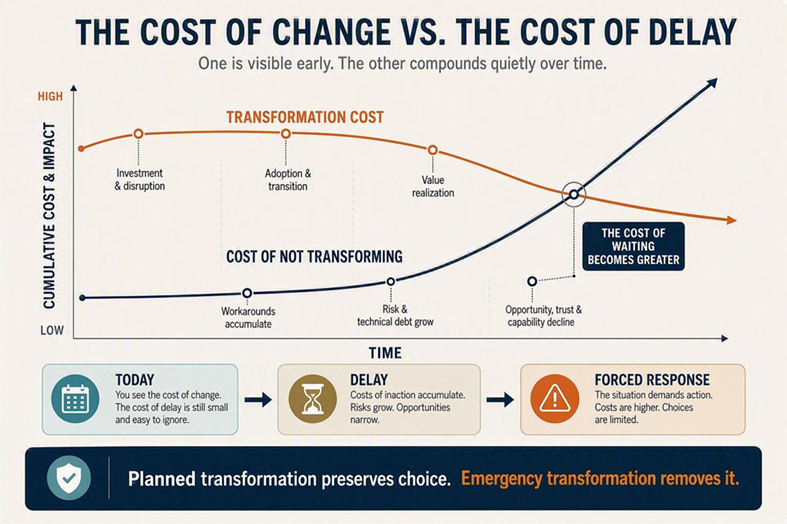
Transform before the Emergency makes the decision for you
The best time to repair a roof is before the storm.
Before the storm, the owner can inspect the damage, compare options, choose the materials, plan the work, and control the budget. Once the ceiling begins to collapse, those choices disappear. The repair becomes urgent, expensive, and disruptive.
Organizations face the same pattern. Planned transformation creates choices. Emergency transformation removes them.
When a critical system fails, a security incident occurs, a new competitor changes expectations, or public trust falls, the organization may finally be forced to act. But at that moment, it is no longer transforming with confidence. It is responding under pressure.
The strongest reason to transform is not fear of the future. It is the ability to shape the future while choices are still available.
The Bill we move into the future
The cost of transformation is usually visible. It appears in budgets, programs, timelines, and difficult conversations.
The cost of not transforming is quieter. It appears in delays, repeated work, missed opportunities, growing risks, tired employees, and customers or citizens who slowly lose trust.
This does not mean every new technology deserves investment or every process must be replaced. It means maintaining the current state should never be treated as a free option.
The bucket under the leak may work today. But it is not protecting the building. It is only delaying the moment when the real cost becomes impossible to ignore.
So, when you look at the transformation you are delaying, are you really saving money, or are you simply moving a larger bill into the future?
And so I leave you with one final question: Are you fixing the roof, or simply becoming more effective at managing the leak?
Share this:


Let me know your thoughts