

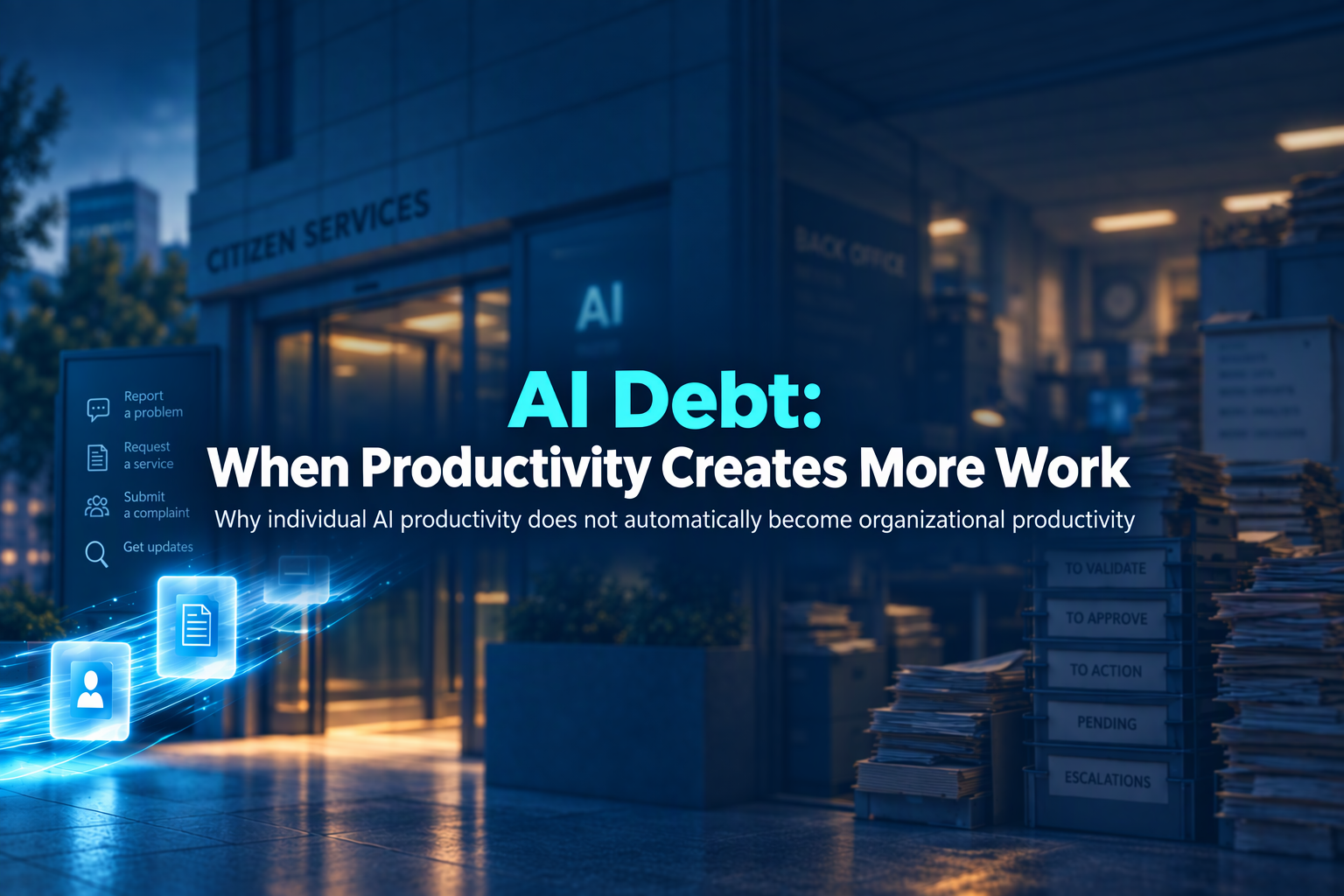
Why individual AI productivity does not automatically become organizational productivity
The Front Door Became Faster
In February 2026, the Chicago Office of Inspector General published an audit of the city’s 311 service, the main channel residents use to request non-emergency services, submit complaints and access information.
The scale is significant. Chicago 311 receives around 2.2 to 2.3 million requests every year. On the surface, this is exactly what a modern government should provide: a simple front door where citizens do not need to know which department is responsible before asking for help.
But the audit exposed a different problem. Citizens and local staff described aspects of the 311 experience as a “black hole.” The audit pointed to unclear status information, inconsistent handling of duplicate requests and limited capacity to use the data to improve services.
Behind the front door, the departments responsible for investigating, deciding and acting still depended on the same people, processes and capacity.
The front door becomes wider. The corridors behind it do not.
The system had become effective at receiving demand. That did not automatically make the city equally effective at fulfilling it.
Now picture that same front door installed on every desk, in every inbox and inside every team. That is exactly what we are building with AI.
Many organizations are now creating the same imbalance with artificial intelligence. AI is helping individuals produce emails, reports, presentations, code, recommendations and tasks faster than ever. The productivity gain is real. But everything we produce eventually arrives somewhere else.
Someone must still read it, understand it, verify it, coordinate around it, make a decision, accept accountability and turn it into action.
What if my productivity gain is simply becoming someone else’s workload?

Individual Productivity Is Not Organizational Productivity
AI improves many individual tasks. It helps us search, summarize, draft, analyse and create. The mistake is assuming that faster individual activity automatically creates a faster organization.
Coordination Debt
According to a randomized field experiment by researchers from Microsoft Research and Harvard Business School, published as a National Bureau of Economic Research working paper, generative AI delivered real benefits across 66 firms and 7,137 knowledge workers. Employees who used it spent about two fewer hours a week on email and reduced the work they did outside normal hours.
But one finding deserves far more attention than it usually gets.
AI changed the work people could do on their own far more than the work that required coordination with others.
An earlier version of the study described the pattern clearly: workers changed the activities they could control independently, such as email, more readily than activities that depended on colleagues, such as meetings. The latest version found no broader shift in the quantity or composition of tasks. In other words, individual work became faster, while the shared work around it stayed largely the same.
This is the heart of AI Debt. Writing can be individual. Alignment is collective. Creating an analysis may take minutes. Agreeing what to do with it can still take weeks. AI may help five teams produce five credible plans, but it does not automatically help those teams agree on one direction.
Perhaps we are measuring AI productivity too close to where work is created. The real measurement should follow the work until it is consumed, coordinated and completed.
| A PRACTICAL TEST Do not ask only, “How much time did AI save the person creating the output?” Also ask: How much time did others spend reading, checking, discussing, approving and maintaining it? Did AI remove work from the system or move it downstream? |
When Creation Becomes Almost Free
For most of human history, creating and distributing information required effort. That effort acted as a natural filter. AI is removing much of that friction.
An email that once required 20 minutes can be produced in seconds. A presentation that took days can be drafted in an hour. Code, images, reports, videos and recommendations can be generated at a scale that was previously impossible.
Attention Debt
But AI has not created more human attention. Our capacity to read carefully, understand context, challenge assumptions and make decisions remains limited or almost the same.
The scarcity has moved: from creation to attention, from information to judgment.
This is attention debt: we generate more than people can meaningfully consume, and every extra message, report or summary competes for the same limited hours.
According to a 2026 peer-reviewed study by Zedai Wang and Chao Tang, published in PLOS ONE, AI-generated short-video content is already showing signs of saturation. Their survey of 513 users linked perceived AI-content saturation with perceptions of low-quality content and content overload. Both were associated with AI-content fatigue, lower satisfaction and lower intention to continue viewing.
The issue is not simply that AI creates more content. It is that production can scale almost infinitely while attention cannot.
Verification Debt
There is a second debt hidden in the same shift. AI lowers the cost of producing an answer much faster than it lowers the cost of knowing whether the answer is correct. Every fluent draft still needs someone to check the facts, confirm the sources, test the reasoning and assess the risk before it can be trusted. When output grows faster than that checking capacity, unverified work either waits in a queue or moves forward on trust it has not earned.
What Happens When We Outsource Thinking?
Cognitive offloading is not new. Writing, calculators, search engines and navigation systems all allow humans to externalize mental effort. The question is not whether we should delegate cognition. It is which parts we can afford to stop practising ourselves.
Cognitive Debt
According to a 2025 study by researchers from Carnegie Mellon University and Microsoft Research, presented at the CHI 2025 conference, 319 knowledge workers shared 936 real examples of how they use generative AI at work. Higher confidence in AI was associated with less critical thinking, while higher confidence in one’s own ability was associated with more. The study also found that AI shifts critical thinking toward verification, integration and oversight.
That is an important nuance. AI does not necessarily remove thinking. It changes where thinking happens. But if people accept fluent output without understanding the evidence or reasoning beneath it, the organization accumulates cognitive debt.
Capability Debt
Junior professionals traditionally develop expertise by researching, drafting, making mistakes, receiving feedback and reviewing the work of others. If AI routinely bypasses these developmental steps, organizations may get expert-looking output today and fewer real experts tomorrow. They must intentionally redesign how future experts learn.
AI should remove unnecessary mental effort. It should not remove the understanding, judgment and ownership that consequential work requires.

The AI Debt We Are Accumulating
Not all AI Debt is the same. Some of it slows the flow of work between people. Some hurts trust in what we produce. Some weakens the people doing the work, and some builds up quietly in the systems we leave behind. I group the eight debts into four families.
| Group | Debt | What becomes easier | Where the debt appears |
| Flow debts | Attention debt | Creation becomes cheap | People must consume and understand more |
| Coordination debt | Individual execution becomes faster | Alignment across people remains constrained | |
| Decision debt | More insights and recommendations appear | Leaders face more choices and escalations | |
| Trust debts | Verification debt | Answers are generated instantly | Truth, evidence and risk still require checking |
| Accountability debt | AI contributes to more decisions and actions | Ownership becomes blurred | |
| Human debts | Cognitive debt | People can outsource thinking | Understanding and judgment may weaken |
| Capability debt | Expert-like output becomes accessible | The path for developing real expertise narrows | |
| System debts | Maintenance debt | Code, agents and automations multiply | Governance, updates and retirement accumulate |
AI Debt is the accumulated attention, coordination, verification, decision, cognitive and maintenance burden created when AI-generated output grows faster than an organization’s capacity to understand, govern and act on it.
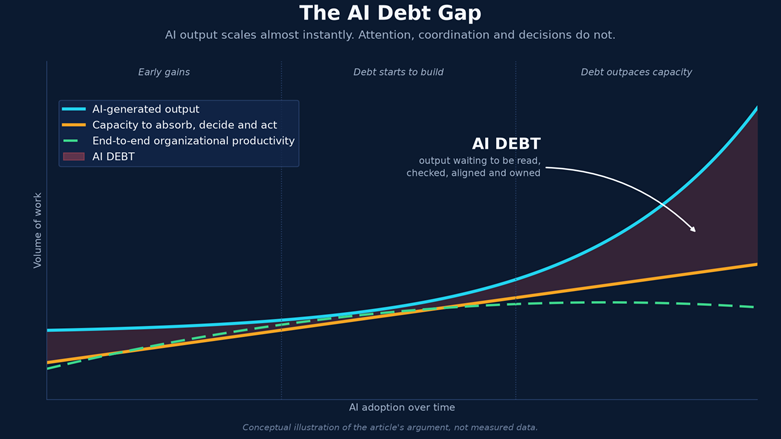
Put together, these debts explain why organizational productivity can stall even while individual output keeps rising. In the early stage of adoption, output and capacity grow together. As AI output accelerates, the organization’s capacity to absorb, decide and act grows much more slowly. The gap between the two is where AI Debt accumulates, and it is where end-to-end productivity starts to flatten.
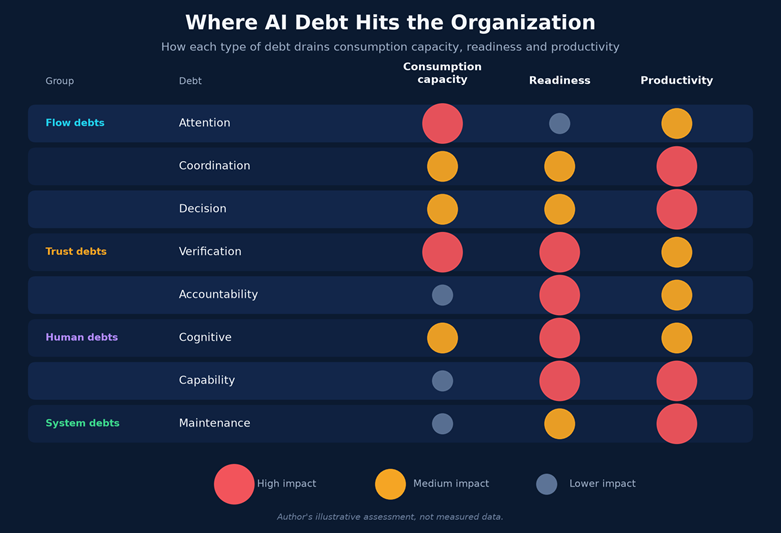
Each debt also drains the organization in a different way. Some reduce consumption capacity: the ability to read, understand and absorb what is produced. Some reduce readiness: the skills, trust and governance needed to act on AI safely. Others hit productivity directly, by slowing the path from output to outcome.
Two everyday examples make this concrete. Take attention debt first. A department starts using AI to turn every meeting into a summary, every update into a report and every idea into a slide deck. Each team feels more productive, but the director now receives far more material than before and reads less of it carefully. The organization’s consumption capacity runs out before a single decision is made.
Now take capability debt. A junior analyst is asked to prepare a first draft of a new policy. With AI, the draft is ready in an hour instead of a week, and it reads well. But the topic needs expert judgment: legal limits, past exceptions and what actually works in practice. The analyst does not have that knowledge yet, so they cannot tell which parts are sound and which are not, and they send it forward with confidence. The work does not disappear. It moves to a senior colleague, who now has to read every line, find the gaps and explain the fixes. AI did what it was asked. The gap was in the ability to judge the result, and someone else paid for it. A readiness gap has quietly become a consumption cost.
The Answer Is Not Less AI
The answer to AI Debt is not to slow down AI. It is to redesign the whole flow of work around it.
Instead of using AI only to write emails faster, ask whether AI can reduce the number of emails people need to read. Instead of generating more reports, ask whether AI can surface only the exceptions that need human attention. Instead of giving executives more analysis, ask whether AI can reduce competing decisions and make ownership clearer.
Organizations should measure team and end-to-end outcomes, not only individual speed. They should treat human attention as a limited resource, preserve deliberate thinking for consequential decisions and design agents to resolve routine work before it reaches a human.
This is where agentic AI can restore the balance. Used well, AI agents do not only help people produce more; they absorb work on the receiving end. They can triage incoming requests, check routine submissions against clear rules, merge duplicates, route each case to the right owner and close simple items end to end, so that only exceptions and consequential decisions reach a person. Humans stay in control: in the loop for decisions that carry real consequences, and on the loop for the routine flow, setting the boundaries, watching how agents perform and stepping in when something unusual happens. I explored how to design that kind of oversight in my previous article, How Humans Stay in Charge of Autonomous AI.
We should stop asking only, “How much faster did AI make this employee?” We should also ask, “How much work did AI remove from the system?”
AI is making knowledge work extraordinarily cheap to create. That is an enormous opportunity. But if creation accelerates while attention, coordination, judgment and decision-making remain constrained, some of the productivity we celebrate today may simply be debt accumulating somewhere else.
So perhaps the most important question is not how much work AI helps us produce. It is how much work AI ultimately helps us remove.
References
- Chicago Office of Inspector General, “OIG Finds Lack of Clarity, Transparency in the 311 Request Process,” 2026.
- Eleanor W. Dillon et al., “Shifting Work Patterns with Generative AI,” NBER Working Paper 33795, revised 2025.
- Hao-Ping Lee et al., “The Impact of Generative AI on Critical Thinking,” CHI 2025.
- Zedai Wang and Chao Tang, “Perceived AIGC Saturation and AI Content Fatigue on Short-Video Platforms,” PLOS ONE, 2026.
- Jiayin Zhi, Harsh Kumar, and Mina Lee, “Investigating the Effects of LLM Use on Critical Thinking Under Time Constraints,” CHI 2026.
