Bread, Planes, and the Question We’re Asking About AI
In Egypt, bread is everything. Subsidized baladi bread sells for almost nothing, a price held steady for decades, not by the market but by the government, on purpose. Every morning, in every neighborhood, the bakery opens and people line up. Bread on the table feels like the most strategic national good in the world. A small, daily signal that the country is taking care of its own people.
Yet Egypt grows only part of the wheat it eats. In 2024–25, Egypt was the world’s largest wheat importer, bringing in about 12.5 million tons, more than Indonesia, more than China. The flour in that loaf came from wheat that crossed the Black Sea, was paid for in US dollars, insured by companies in London, shipped on boats from other countries, and grown from seeds developed in labs far away. Bread on the table today is national. Bread on the table next year depends on many things the country does not fully own.
Take another example. Almost every country has a national airline. The planes are painted in national colors, the flag is on the tail, and people feel proud when they see it at the airport. But the aircraft itself was built by Boeing or Airbus. The engines come from Britain. The fuel is imported. The pilots trained on foreign simulators. The flight routes follow rules written by international bodies. And still, when the plane lands with the flag on the tail, something real is there. A national capability, even though every part of it came from somewhere else.
This is what sovereignty actually looks like today. Not a wall around the country.
A series of choices about which parts to own, which parts to share, and which parts to depend on, with your eyes open.
Sovereignty is an old idea
Before we talk about AI, it helps to remember that sovereignty is not a new word. It is one of the oldest ideas in how nations live. For centuries it came in two classic forms.
The first is political sovereignty: the power of a country to rule itself, to make its own laws, and to decide its own future without another country telling it what to do. This is the flag, the borders, the parliament. It is the oldest meaning of the word.
The second is economic sovereignty: the power of a country to run its own economy, to protect its resources, and above all to feed its own people. And here is where bread comes back. The Egyptian loaf is the perfect picture of economic sovereignty: the state does not grow most of the wheat, but it controls the price, owns the bakeries, and makes sure the bread reaches every citizen. The country leans on the world for the grain and keeps for itself the part that matters most.
What we now call digital sovereignty, technology sovereignty, and sovereign AI are simply the newest members of this same old family. The questions have not changed: what must we control, what can we share, and what must we never let someone else switch off? Only the subject has changed, from land and wheat to chips and models.
This is also the right way to think about sovereign AI, a term that has moved, in less than two years, from a phrase in speeches to a real requirement in government contracts. But most of the conversation is still stuck at the phrase. We argue about whether AI should be “ours” or “theirs,” as if the answer were simply yes or no. As if sovereignty were a fence, and not a recipe.
It is not a fence. It never was. And the countries that get this right, the ones that build real AI capability over the next ten years, will be the ones that ask a sharper question:
Out of all the parts that go into an AI system, which ones must we own, which can we share, and which ones must we always be able to walk away from?
Why “Sovereign AI” Suddenly Matters
For years, “sovereign AI” sounded like a slogan. Today it is becoming a line item in real government contracts. Three things changed this, all within about the last 18 months.
First, the world learned that access to AI hardware can be turned off. The most powerful AI chips come from a small number of companies, and the governments where those companies sit can decide who is allowed to buy them. Over the past two years these rules have tightened, loosened, and changed again, and a new tariff was added on top. The lesson for every other country was simple: the engine that runs modern AI is not fully in your hands. Someone else can change the rules while you are mid-flight.
Second, AI became a legal matter, not just a technical one. Europe’s new AI law is rolling out in stages, with real duties for AI providers and real fines for breaking them. Other regions are writing their own rules too. Suddenly, where your AI runs and who can answer for it are questions with legal weight.
Third, AI stopped only answering questions and started taking actions. New “agentic” systems can book, file, approve, and decide on a government’s behalf. When software acts for the state, the state needs to know it can see what that software does, control it, and stop it.
Put together, these three forces turned a comfortable slogan into an uncomfortable question every government now has to answer.
The Layers of Sovereign AI
People talk about “Sovereign AI” as if it is one thing. It is not. It is a stack of layers, and you can be sovereign in some and fully dependent in others. So the honest question is never “Do we have Sovereign AI, yes or no?” The honest question is “Which layers do we control, and which ones does someone else control for us?”
Think of it like the bread supply chain from the opening. You can own the bakeries on every corner and still not be food-sovereign, because the wheat, the ships, and the price are decided somewhere else. AI is the same. Owning the last visible step means very little if the steps underneath belong to others. This is why the World Economic Forum describes sovereign AI not as a single product but as a national capability that “codifies a country’s culture, history, and collective intelligence,” something built across many layers, not bought in one.
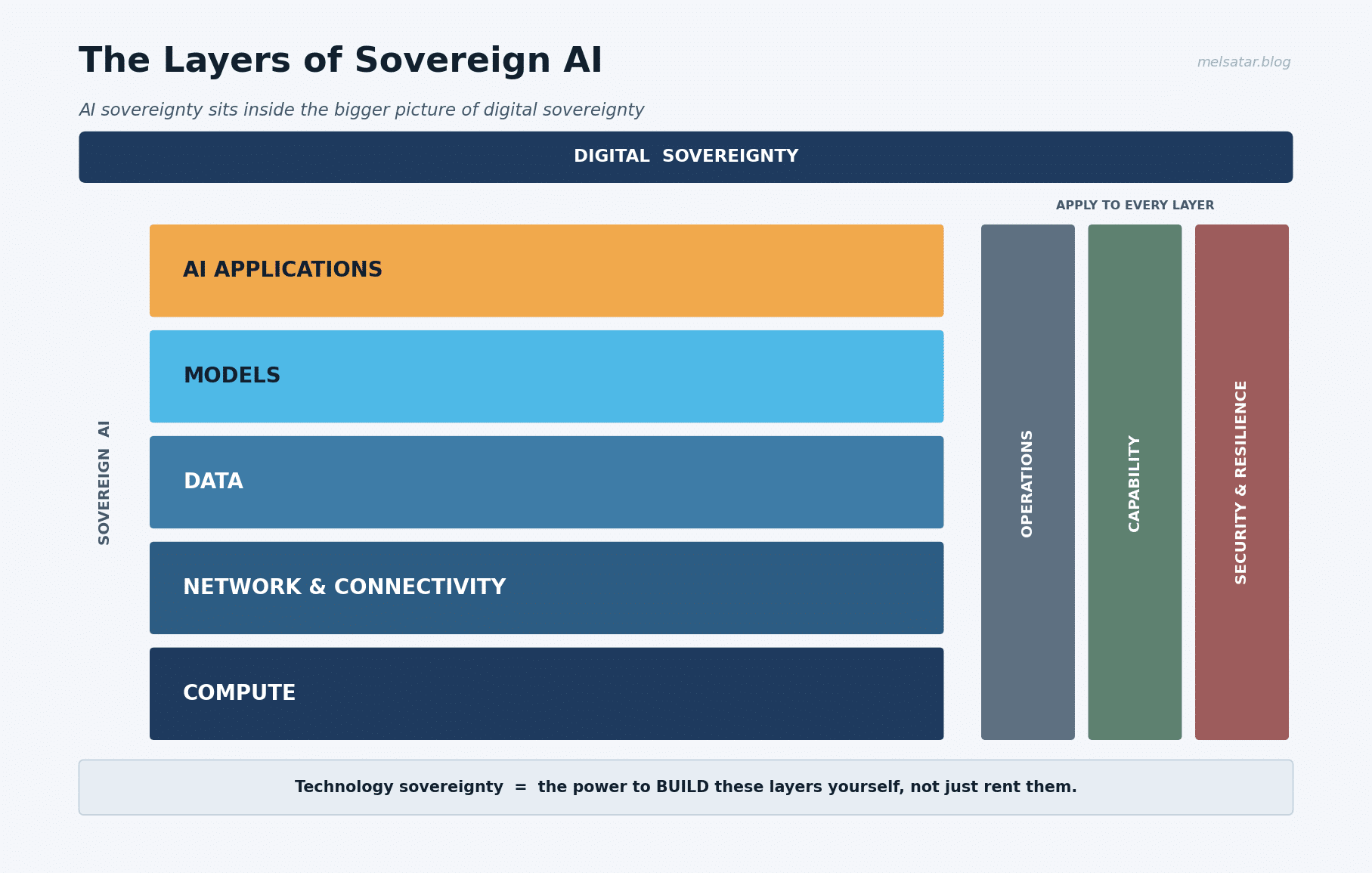
The five core layers, bottom to top:
- Compute. The chips and data centres where AI is trained and run. This is the hardest layer to control, because a handful of companies and countries make the advanced chips, and access to them is now a matter of export rules, not just price. This is the layer most governments quietly depend on the most.
- Network & Connectivity. The cables, the fibre, the cross-border links that move the data and connect to the compute. If your AI runs in another country, this layer decides whether you can even reach it, and who can cut you off.
- Data. Your national data: citizen records, health, tax, maps, language. This is the layer governments instinctively think of first, and it is important. But notice it sits in the middle of the stack, not at the top. Controlling your data while renting everything else is a common and incomplete kind of sovereignty.
- Models. The trained AI systems themselves, the “brains.” You can use someone else’s model, fine-tune an open one, or build your own. Most countries will not train frontier models from scratch. The realistic sovereignty question here is about choice and substitution: if one model is cut off or changes its terms, do you have an alternative?
- AI Applications. The actual services citizens and officials touch: the benefits chatbot, the fraud-detection tool, the translation service. This is the visible top of the stack. It is also the easiest layer to control, which is exactly why controlling only this layer can create a false sense of sovereignty.
Together, these five layers are what we mean by Sovereign AI (the bracket on the left of the diagram).
The three cross-cutting concerns, they apply to every layer:
- Operations: can you actually run it, day after day, without foreign hands on the controls?
- Capability: do you have the people and skills, or does the knowledge leave when a vendor leaves?
- Security & Resilience: can the whole stack survive an attack, an outage, or a political shock?
These three are drawn as vertical bars on the right because they cut through all five layers. A weakness in any one of them weakens the entire stack. You can own every layer on paper and still lose control if you cannot operate it, staff it, or defend it.
Where digital sovereignty and technology sovereignty fit
Two bigger ideas sit around this stack, and it helps to keep them straight.
Digital sovereignty is the umbrella across the top of the diagram. It is the broad idea of a country having control over its digital systems (data, software, cloud, and infrastructure), not only its AI. The European Commission now even scores cloud providers on this in its Cloud Sovereignty Framework, measuring how far a service is genuinely anchored under your own legal and operational control rather than someone else’s. Sovereign AI is the AI-shaped slice of that bigger umbrella.
Technology sovereignty is the harder, deeper idea written along the bottom: the power to build these layers yourself, not just rent them. The clearest definition comes from Fraunhofer ISI, which calls it the ability of a state “to provide the technologies it deems critical… and to develop these or source them from other economic areas without one-sided structural dependency.”
Read that carefully. It is not a call to make everything at home. As another widely-cited study frames it, technology sovereignty is “ability, not autarky.” The goal is not to cut yourself off. The goal is to never be in a position where one supplier, one country, or one rule change can switch you off.
That distinction is the whole point of this article. Sovereignty is not about doing everything alone. It is about keeping real choices open at every layer, so that depending on others stays a decision you made, not a trap you fell into.
What Governments Can Actually Do
So sovereignty is not one switch. It is a menu of controls, one set for each layer. A government does not have to grab every control. It has to decide which ones matter for which use case, and accept that each one has a price. Here is the menu, layer by layer.
Compute: own it, rent it, or share it. This is the most expensive layer and the hardest to fake. A country can build its own AI data centre, like the EU is doing with public “AI factories.” Poland’s Gaia supercomputer in Kraków, funded jointly by the EU and the Polish state, gives local researchers and startups national compute they do not have to import. India is doing it at industrial scale through private superclusters. But owning chips is a trap as much as a prize: the hardware ages fast, and someone has to keep paying to replace it, what one writer called the treadmill beneath the supercluster. The cheaper controls are renting sovereign cloud capacity inside your borders, or pooling compute regionally so no single country pays for everything alone.
Network & Connectivity: control the wires. Decide whether your AI traffic can leave the country, which cables and routes it uses, and whether a foreign provider can be cut off from reaching it. This is quiet but real sovereignty: a model is useless if the connection to it can be switched off from outside.
Data: keep it home, or at least keep the keys. This is the control most governments reach for first because it is the cheapest. Data localization (the data must physically stay inside the country), data residency (it stays in a chosen region), and holding your own encryption keys all let a state keep authority over its information without building a single chip. For health records, tax data, and citizen identity, this is usually the first line drawn.
Models: borrow the brain, but make it yours. A country does not need to train a giant model from zero to have sovereignty here. It can take an open-weight model and adapt it. The Gulf has made this the regional strategy: the UAE’s TII released Falcon as open weights, then built Falcon-H1 Arabic, now one of the strongest Arabic models in the world, a model the region controls, in its own language, that any government can download and run on its own compute. Open weights turn “we rent a foreign brain” into “we own a copy and can inspect it.”
AI Applications: own the front door. The app that the citizen or the civil servant actually touches, the rules it follows, the audit logs it keeps, the ability to turn it off: this is the layer closest to the public, and often the most important to control even when the layers below it are rented.
You may have noticed this menu only walks the five core layers (Compute, Network, Data, Models, Applications) and not the three cross-cutting concerns from the last section. That is because the five core layers are places where you make a buying decision: you build, rent, or pool something, and you can point to it. The cross-cutting concerns (Operations, Capability, Security & Resilience) are different in kind. They are not things you buy at one spot on the stack; they are disciplines every government should practise across all of it, exactly as the last section described. You do not “purchase security” at the Data layer. You run it everywhere, on every layer you control.
And there is one more pattern worth drawing out, because it quietly decides most national AI strategies. The cost of controlling each layer is not equal. It gets cheaper, faster, and higher-leverage as you move up the stack, and heavier, slower, and more capital-hungry as you move down:

Owning the front-door application is something almost any government can do this year. Holding your own data and keys is harder but still affordable. Adapting an open model is within reach for a national lab. But controlling compute, the wide, dark base of the pyramid, is where the real money, time, and risk live. This is the gradient that traps people: it is tempting to plant the flag at the bottom, on chips, because it feels like the most sovereign thing to own. Often it is the most expensive way to buy the least flexibility. That mistake is exactly what the next section is about.
What Most Strategies Get Wrong
Most national AI plans fail in the same few ways. They are honest mistakes, but expensive ones.
Mistake 1
Confusing owning with controlling. Governments plant their flag on compute, because chips are the most visible, most physical thing on the stack. It feels like the most sovereign layer. But as the pyramid showed, the base is the costliest control and the slowest to change. A country can spend a fortune building its own data center and still rent the model, the data tools, and the application sitting on top, owning the heavy bottom while renting everything that actually touches the citizen. Sovereignty is control where it matters, not ownership of what is most expensive.
Mistake 2
Building a flag, not a tool. This is the “we must have our own national model” race. Training a giant model from zero to prove independence, which often arrives months behind the rest of the world, costs a fortune, and is used by almost no one. The World Economic Forum warned that the sovereign-AI idea is as fraught as it is appealing, precisely because the prestige version can crowd out the useful one. The smarter regional play, as the last section showed, is to take strong open weights and make them yours.
Mistake 3
Mistaking a wall for sovereignty. Some plans try to cut the country off from the world: ban foreign chips, block foreign cloud, forbid foreign models. The logic feels safe — if nothing comes in, no one outside can control us. But that confuses isolation with sovereignty.
Think back to the bread. Egypt is the world’s largest wheat importer, yet no one calls it weak for it. The strength isn’t in growing every grain at home — it’s in managing the supply so well that the bread keeps arriving, and the country could switch suppliers if it had to. Sovereignty, as we said earlier, is ability, not autarky.
A nation that walls itself off gets the opposite of what it wanted: total control over a system too weak to use — homegrown chips a generation behind, models its own researchers quietly avoid. You own all of it, and all of it is falling behind.
Real sovereignty keeps the option to say no — to a vendor, a model, a country — while staying strong enough that saying no is a choice, not a sentence.
Mistake 4
Buying the layers, forgetting the people. This is the quietest and most common one. A government buys the data centre, signs the cloud deal, downloads the model, then has no engineers to run it, no security team to defend it, and no budget for next year’s chips (the treadmill again). The cross-cutting disciplines from the last section (Operations, Capability, Security & Resilience) are not optional extras. A layer you cannot operate is not sovereign. It is just expensive.
Sovereignty is a set of choices about control, matched to need, not a trophy to put on a shelf. The next section looks at how the region is actually making those choices.
How the Region Is Choosing
The five layers and the controls menu can feel abstract on paper. So let us look at how real governments in our region are filling them in. Three neighbours, the UAE, Saudi Arabia, and Egypt, have each made a clear bet. They are not choosing the same things, and that is the most useful part. It shows there is no single “correct” sovereign-AI plan, only the plan that fits what a country has and what it wants.
The UAE: rent the compute, keep the keys. The UAE went big on the heaviest, most expensive layer (compute) but it refused to pay for it alone. It built Stargate UAE, a giant data-centre cluster in Abu Dhabi, together with a group of foreign partners (OpenAI, Oracle, NVIDIA, SoftBank, Cisco). The clever part is the ownership: the local company G42 keeps the majority stake, so the country holds the keys even though the technology is shared. This is the “ability, not autarky” idea made real: partner for the hardware, but make sure control stays at home. And remember from earlier sections: the UAE also funds its own open models (Falcon), so it is not renting everything.
Saudi Arabia: build the whole stack, and meet the real bottleneck. Saudi Arabia chose the most ambitious path. Through its sovereign fund it created HUMAIN, a company meant to build every layer of the stack inside the Kingdom: compute, data centres, and its own Arabic model, ALLaM. The goal is openly stated: to become one of the world’s top AI providers. But Saudi Arabia is also living proof of why the cross-cutting concerns matter. The same reporting notes a large talent gap: the country has to hire heavily from abroad to run what it is building. You can buy compute in a year; you cannot grow a generation of engineers that fast. This is the Capability concern from earlier, showing up in the real world.
Egypt: start with the people and the data, build the model next. Egypt is not trying to out-spend its neighbours on chips. Its National AI Strategy 2025–2030 puts the weight on the upper, cheaper, higher-leverage layers first: skills, data, and a planned national foundation model trained on local data. The strategy says the goal in plain words: to move “from using foreign technology to creating Sovereign AI.” That is a sensible bet for a country whose biggest asset is its people, not its capital budget. It picks the layers where a dollar buys the most sovereignty.
The lesson. Look at the three together and the pattern is clear. The UAE bought compute but kept control. Saudi Arabia is building everything and discovering that people, not machines, are the hard part. Egypt is starting where its strength is. None of them tried to own all five layers at full depth, because, as the cost pyramid showed, that is the most expensive way to buy the least flexibility. Each one read its own situation and chose its layers on purpose.
The next section is the honest part: every one of these choices costs something.
The Trade-Off
Everything so far might make sovereignty sound like a free win: pick your layers, keep control, done. It is not free. Every choice on the menu costs something, and the honest part of this whole conversation is naming what you pay. There is no option that gives you full control, full speed, and top quality all at once. You get to pick two, and you give up some of the third.
You pay in money. The lower you go in the stack, the bigger the bill. Owning compute means buying chips that lose value fast and need replacing in a few years. A country can spend its way to a national data centre, but that money is then not spent on schools, health, or roads. Sovereignty at the compute layer is real, but it is the most expensive sovereignty you can buy.
You pay in speed. Building your own thing is slower than renting someone else’s. A government that insists on training its own model from scratch will watch others ship useful services first. Sometimes that wait is worth it. Sometimes the problem in front of you (a flood warning, a hospital queue, a tax form) needed a solution last year, and waiting three years for a “sovereign” version helps no one. Control bought with delay can quietly become control over nothing.
You pay in quality. A local model trained on local data is a wonderful thing for language, culture, and law. But the global frontier models are trained on far more compute and far more data, and for many tasks they are simply better today. If you require everything to run on the home-grown option, you may be handing your citizens a weaker tool in the name of independence. That can be the right call for sensitive work, and the wrong call for ordinary work where good-enough, fast, and cheap matters more.
The trap is pretending the trade-off does not exist. The mistake is not choosing control. The mistake is choosing control everywhere, at full depth, and acting surprised when the bill, the delay, and the quality gap all arrive together. As we said earlier, sovereignty is an ability, not autarky: the ability to decide, case by case, where you will pay the price and where you will not.
So the real question is not “how sovereign are we?” It is “sovereign over what, and what are we willing to pay for it?” A flood-prediction tool and a citizens’ identity database do not deserve the same answer. One can happily run on a rented global model. The other may justify every expensive layer you can build. Treating them the same, pulling everything down to the most controlled, most costly setting “to be safe,” is not caution. It is just an expensive way to avoid making a decision.
That is exactly the decision the next section helps you make, with a simple scorecard.
A Simple Scorecard: Where Should It Run?
A note before the numbers: this is an aspirational model. It doesn’t cover every factor or every control, just the few that drive the decision. The same model can grow: add rows for new factors or new locks whenever you need them.
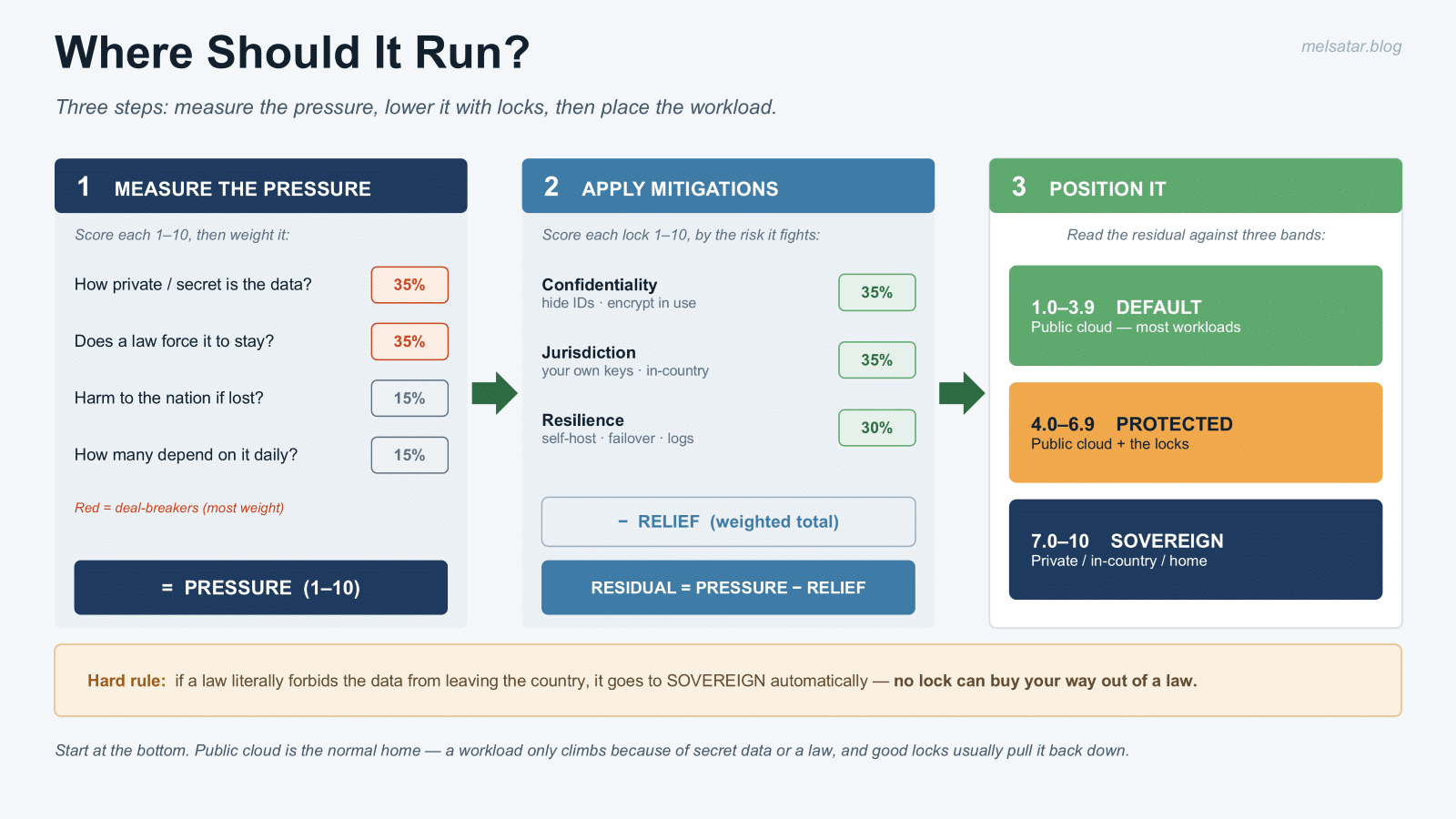
Step 1: Measure the pressure
Pick a score from 1 to 10 for each factor. The table tells you what low, middle, and high look like. Multiply by the weight and add it up.
| Factor | Weight | 1–3 (low) | 4–6 (medium) | 7–10 (high) |
| How private/secret is the data? | 35% | Public or already-open info | Ordinary personal or business data (names, financials) | Deeply private / state secret (health, biometrics, security) |
| Does a law force it to stay? | 35% | No rule | Industry guidance prefers in-country | Law clearly forbids it leaving |
| Harm if we lost access? | 15% | Minor inconvenience | Real disruption, recoverable | Critical national damage |
| How many depend on it daily? | 15% | A few / back-office | A department or region | The whole nation, every day |
Pressure = (each score × its weight), added up, on the same 1–10 scale.
Step 2: Apply the mitigations
Score each lock 1 to 10 for how fully you apply it. Again the table shows low, middle, and high. Multiply by the group weight, add up, and subtract from the pressure.
| Risk it fights | Weight | 1–3 (weak) | 4–6 (partial) | 7–10 (strong) |
| Someone could read the data (confidentiality) | 35% | IDs stay visible | IDs partly masked | Fully de-identified and encrypted while in use |
| A foreign law could reach it (jurisdiction) | 35% | Provider holds keys, foreign region | In-country region or your own keys | Your keys the provider can’t read and in-country |
| We could lose access / get locked in (resilience) | 30% | Single provider, no exit | Failover or open model | Self-hosted/portable plus access approval + tamper-proof logs |
Relief = (each lock-score × its weight), added up.
Residual pressure = Pressure − Relief (never below 1).
Step 3: Position it to a deployment model
| Residual pressure | Band | Where it runs |
| 1.0 – 3.9 | Default | Public cloud, most workloads |
| 4.0 – 6.9 | Protected | Public cloud + the locks above |
| 7.0 – 10 | Sovereign | Private / in-country / build at home |
One hard rule sits above the whole scorecard: if a law literally says the data may not leave the country, the answer is automatically. No lock can buy your way out of a law.
Putting it to work: corporate tax fraud vs. citizen benefit fraud
Catching companies cheating on tax
Step 1, pressure:
| Factor | Score | × Weight | = |
| Data sensitivity (company tax records) | 6 | 35% | 2.10 |
| Legal must-stay (financial rules, no hard ban) | 3 | 35% | 1.05 |
| National harm if lost | 4 | 15% | 0.60 |
| Daily dependence (back-office check) | 3 | 15% | 0.45 |
| Pressure | 4.20 |
Step 2, mitigation (a company can be fully pseudonymised, so confidentiality is strong):
| Risk group | Lock-score | × Weight | = |
| Confidentiality (hide company IDs + encrypt in use) | 8 | 35% | 2.80 |
| Jurisdiction (hold your own keys) | 7 | 35% | 2.45 |
| Resilience (not really needed) | 2 | 30% | 0.60 |
| Relief | 5.85 |
Residual = 4.20 − 5.85 → floored at 1.0.
Step 3, position: Default → public cloud. Cheap, fast, ready today.
Catching citizens cheating on benefits, same model, very different result:
- Step 1: Pressure ≈ 7.5 (sensitivity 9, plus millions depend on it daily).
- Step 2: The confidentiality lock is weaker, a live benefits system must act on real people, so you can’t fully strip the IDs (lock-score ~3). Relief ≈ 3.0 → residual ≈ 4.5.
- Step 3: Protected, and if national-ID law forbids it leaving, the hard rule overrides to.
The lesson: the corporate case is easier precisely because you can hide the identities more completely. The same data work that’s impossible for a live citizen service is cheap for a fraud-check on companies.
How this looks in the real world
Every major provider and regulator is building this same “score it, then lower it” logic, and they disagree on how far the locks go:
- Cloud providers each ship a sovereign tier. Microsoft’s Sovereign Cloud (public, private, national-partner forms, with customer-held keys, confidential computing, access logs), AWS’s European Sovereign Cloud and its Sovereign Reference Framework, Google’s air-gapped option, competing mostly on how many locks they offer. Microsoft even publishes a plain ladder (Public → Internal → Confidential → Secret) where each step requires more locks.
- Regulators push the other way. The EU’s 2026 tech-sovereignty moves would restrict US clouds for the most sensitive government data, citing the US CLOUD Act, which can compel a US company to hand over data even when stored abroad. The Netherlands blocked a government identity contract on exactly that worry.
The honest takeaway: locks lower your risk, but they don’t erase a foreign legal reach. That is why the hard legal rule overrides the score, and why the Sovereign band exists at all.
The Close: Bread, Eyes Open
Egypt buys more wheat from the world than any other country on earth. And yet bread, eish, the same word we use for life, is the most sovereign thing we have. The state does not grow most of the grain. But it owns the bakeries, sets the subsidy, and decides how a loaf reaches a citizen’s hand each morning. Egypt leans on the world for the wheat and keeps for itself the part that feeds its people.
The national airline tells the same story. The planes are built abroad. The engines are foreign. The booking system runs on software written somewhere else. But the flag on the tail is ours, the routes are our decision, and when we need to bring our people home, the call is ours to make.
Sovereign AI is bread, and it is the airline.
No country will grow all its own wheat. None will mine the silicon, design the chips, train every model, and own every layer from sand to citizen. Everything we walked through, the cost of the compute, the scarcity of the skills, the weight of the data laws, makes full self-sufficiency a fantasy for almost everyone, wealthy nations included.
So the real question was never “build everything, or depend on everyone.” It was quieter and harder: which loaf must we be able to bake ourselves, even on the worst day?
That is what the layers were for. That is what the scorecard was for. You measure the pressure honestly. You apply the locks you actually hold. You read where each workload lands: the public cloud for most of it, the protected middle for the sensitive parts, and the sovereign shelf only for the few things a law or a secret will never let leave home. And you remember the hard rule: no clever lock buys your way out of a law.
Eyes open means knowing exactly what you lean on, what it would cost you if it were cut, and having the bakery ready before the morning you need it.
Sovereignty is not a wall. It is not a flag you plant once and forget. It is a set of careful, unattractive choices, repeated, reviewed, and paid for, that let a nation keep feeding its people, flying its flag, and making its own decisions, even when the world outside turns hard.
Build what you must. Buy what you can. Keep your eyes open. And never lose control.
References
- World Economic Forum, What is sovereign AI and why is the concept so appealing (and fraught)? — https://www.weforum.org/stories/2024/11/what-is-sovereign-ai-and-why-is-the-concept-so-appealing-and-fraught/
- European Commission, Cloud Sovereignty Framework — https://commission.europa.eu/document/download/09579818-64a6-4dd5-9577-446ab6219113_en?filename=Cloud-Sovereignty-Framework.pdf
- Fraunhofer ISI, Technology Sovereignty — https://www.isi.fraunhofer.de/content/dam/isi/dokumente/publikationen/technology_sovereignty.pdf
- CESifo Working Paper, Technology Sovereignty: Ability, not Autarky — https://www.ifo.de/DocDL/cesifo1_wp9139.pdf
- Data Center Dynamics, Gaia AI supercomputer launched in Kraków, Poland — https://www.datacenterdynamics.com/en/news/gaia-ai-supercomputer-launched-in-krak%C3%B3w-poland/
- Rising Kashmir, The treadmill beneath the supercluster — https://risingkashmir.com/the-treadmill-beneath-the-supercluster/
- TII, Falcon Arabic — https://falconllm.tii.ae/falcon-arabic.html
- ATRC, Abu Dhabi’s TII launches Falcon-H1 Arabic — https://atrc.gov.ae/news/abu-dhabis-tii-launches-falcon-h1-arabic-establishing-the-worlds-leading-arabic-ai-model
- G42, Global tech alliance launches Stargate UAE — https://www.g42.ai/resources/news/global-tech-alliance-launches-stargate-uae
- SoftBank Group, Press release (G42 majority stake) — https://group.softbank/en/news/press/20250522
- Saudi Press Agency, HUMAIN — https://www.spa.gov.sa/en/N2385004
- CNBC, Saudi Arabia wants to be world’s third-largest AI provider (HUMAIN, ALLaM) — https://www.cnbc.com/2025/08/27/saudi-arabia-wants-to-be-worlds-third-largest-ai-provider-humain.html
- Arab Republic of Egypt, National AI Strategy 2025–2030 — https://ai.gov.eg/SynchedFiles/en/Resources/AIstrategy%20English%2016-1-2025-1.pdf
Share this: