In earlier articles, I discussed Enterprise Architecture as more than a set of frameworks, diagrams, or governance practices for digital strategy and transformation.
At its core, Enterprise Architecture is about making informed decisions in complex environments. It focuses on aligning technology with business intent. It also involves shaping systems that can evolve over time.
The rise of AI does not invalidate this understanding. It amplifies its importance more than ever. AI is becoming a core component in building entire systems or critical parts of them. Architecture and system thinking are no longer optional disciplines. They are essential to deliberately evaluate how systems are designed, how they behave, and how they evolve.
AI also changes how we engage with systems as humans, and how humans and AI interact. The Enterprise Architect’s role now extends beyond bridging business and technology. Architects are increasingly tasked with bridging human and artificial intelligence, ensuring that AI systems align with business goals, ethical standards, and human workflows.
AI introduces uncertainty, learning behaviors, probabilistic outcomes, and ethical considerations directly into enterprise systems. As a result, the Enterprise Architect role is no longer centered on designing static structures, but on orchestrating dynamic, data driven, and continuously evolving ecosystems.
This shift is not primarily about adopting new tools. It is about developing new skills and emphasizing the right capabilities to guide organizations through the AI era.
The AI era does not diminish the architect’s role. It elevates the architect’s role. This era demands new skills and a renewed vision. Architects must guide enterprises responsibly into the future.
In this article, I will focus on the core skills Enterprise Architects need today. I will explain why they matter. Additionally, I will discuss how they shape the future of AI-enabled enterprises.
AI Literacy:
Seeing Beyond the Buzzwords
AI is no longer a distant concept reserved for data scientists, it’s becoming part of everyday enterprise systems. For architects, this doesn’t mean writing code or training models. It means knowing enough to ask the right questions, spot risks, and translate AI’s potential into business reality.
Think of it like being a navigator on a ship: you don’t need to know how to build the vessel or repair the engine, but you must understand the currents, weather patterns, and routes well enough to guide the crew safely to their destination. In the same way, architects need to understand machine learning, natural language processing, and generative AI just enough to anticipate opportunities and pitfalls.
For example, a global bank that considered deploying a generative AI chatbot for customer service. The enterprise architect stepped in, highlighting risks around hallucinations and regulatory compliance. Instead of rushing ahead, the bank adopted a retrieval-augmented model with tighter governance. A decision that balanced innovation with trust. This is AI literacy in action: not building the model but guiding the organization toward responsible adoption.
But literacy cannot be treated as a one‑time achievement. AI evolves too quickly. Architects must embed continuous learning and adaptation into enterprise culture. This means creating feedback loops, updating teams as models change, and positioning AI literacy as part of the organization’s identity.
Recent research confirms this shift. A systematic review on enterprise architecture and AI found that architects increasingly act as “strategic translators,” ensuring AI initiatives align with organizational goals rather than becoming fragmented experiments.
Takeaway:
- Follow at least one AI-focused newsletter or journal to stay current.
- Learn the basics of how models consume data and produce outcomes.
- Always ask: Does this AI initiative align with our enterprise strategy, or is it just hype?
If literacy is about understanding AI, behavioral thinking is about anticipating how it acts once deployed. The next skill shifts focus from static knowledge to dynamic system behavior.
From Structural to Behavioral Thinking:
Designing for Living Systems
For years, Enterprise Architecture has been strongly influenced by structural thinking rather than behavioral thinking: layers of applications, data, standardized platforms, and well-defined boundaries. That worked when systems behaved predictably, like machines following fixed rules. But AI changes the game. Systems now learn, adapt, and sometimes surprise us.
This is where behavioral thinking becomes essential. Instead of focusing only on tidy diagrams or rigid boundaries, architects must ask deeper questions:
- How will this system behave when exposed to new data?
- What feedback loops will emerge, and how will they affect outcomes?
- Where might unintended consequences appear when AI interacts with humans and processes?
- How will governance adapt when models evolve over time?
- What signals should we monitor continuously to ensure trust and fairness?
Take the example of a logistics company that embedded a predictive AI model into its routing system. In isolation, the model performed well — faster deliveries, optimized routes. But once deployed, fuel costs spiked. Why? The model optimized for speed without considering fuel efficiency. The enterprise architect had to redesign the system to include feedback loops for cost signals, balancing speed with sustainability.
This illustrates the shift: AI systems are not static artifacts, they are living ecosystems. Architects must anticipate emergent behaviors, interactions, and ripple effects across workflows and accountability. Governance, too, must evolve — not as static checkpoints, but as continuous monitoring and adjustment.
Recent studies highlight this challenge. Research on AI in socio-technical systems shows that models often create ripple effects across workflows, accountability, and even employee trust. Architects who adopt behavioral thinking are better equipped to foresee these dynamics and design systems that adapt responsibly.
Takeaway:
- Think in loops, not phases.
- Anticipate unintended consequences when AI interacts with humans and processes.
- Treat governance as continuous oversight, not one-time approval.
Of course, behavior is only as trustworthy as the data driving it. That’s why the next skill emphasizes treating data not as a passive resource, but as a living responsibility.
Data as an Architectural Responsibility:
From Static Assets to Living Inputs
Data has always been central to enterprise architecture, but in the AI era it shifts from being descriptive to being operational. It no longer just supports analytics or reporting. It directly drives automated decisions, recommendations, and actions. That makes data not just an asset, but a living input into enterprise behavior.
This raises new responsibilities for architects. It is no longer enough to ask whether the data exists or what data do we have. The real questions are:
- Can this data be trusted to drive decisions without human intervention?
- Does it represent all the people and contexts it will affect?
- How do we monitor bias, fairness, and ethical implications alongside accuracy and completeness?
Consider the case of a healthcare provider that deployed an AI triage tool trained on historical patient data. The dataset underrepresented certain demographics, and the model began producing biased urgency scores. The enterprise architect led a data audit, rebalanced the dataset, and introduced governance checks to ensure fairness. This intervention turned a potentially harmful system into one that aligned with both medical ethics and organizational values.
Studies confirm this challenge. Research on AI in healthcare shows that biased datasets can lead to discriminatory outcomes, reinforcing inequities rather than solving them. Architects who treat data as a living responsibility, not just a technical layer, are better positioned to prevent these harms and ensure AI systems remain trustworthy.
Takeaway:
- Data must be treated as a dynamic input rather than a static resource.
- Datasets should be evaluated for fairness, representativeness, and ethical implications.
- Governance must be embedded at the architectural level to ensure trust and integrity.
Once data is seen as a living input, the challenge becomes managing AI initiatives strategically. Architects must move from isolated projects to portfolio thinking that balances stability with innovation.
Strategic AI Investment Management:
Shaping a Portfolio for Lasting Value
AI adoption is booming. Every department wants its own solution, often launching pilots without coordination or alignment. This creates duplication, wasted resources, and fragmented systems. Enterprise Architects step in to bring coherence and strategy.
Rather than micromanaging projects, architects act as investment managers. They structure AI initiatives as a portfolio, balancing stability with innovation. Some projects deliver steady value, while others explore experimental ideas. All must contribute to a cohesive enterprise strategy.
For example, a retail group that faced dozens of disconnected AI pilots. Marketing was testing customer sentiment analysis, supply chain was experimenting with demand forecasting and inventory optimization, and HR was exploring AI-driven recruitment. The enterprise architect categorized these initiatives into two groups:
- Core value drivers such as demand forecasting and inventory optimization
- Exploratory pilots such as sentiment analysis and AI-driven recruitment
By framing AI adoption as a portfolio, leadership could allocate budget and talent deliberately. This avoided duplication, reduced hype-driven spending, and ensured that innovation aligned with long-term goals.
Recent industry reports emphasize this approach. Analysts note that enterprises treating AI as a portfolio investment achieve higher ROI and resilience compared to those chasing isolated pilots.
Takeaway:
- Evaluate AI initiatives for alignment with enterprise strategy
- Balance predictable value projects with exploratory pilots
- Treat resources as part of a portfolio, not as fragmented experiments
But investment without oversight is dangerous. Every AI initiative must be safeguarded by governance and ethical checks that protect trust and compliance.
Risk, Governance, and Ethical Oversight:
Safeguarding Trust in AI
AI systems are powerful, but without governance they can quickly erode trust. Enterprise Architects are not only designers of systems, they are guardians of ethics, compliance, and reputation. The challenge is to ensure that innovation does not outpace responsibility.
The right questions for architects in this space are:
- How transparent is the model’s decision-making process?
- What risks emerge when data flows across departments or vendors?
- Where do accountability and consent need to be reinforced?
- How do we monitor evolving regulations and adapt systems accordingly?
For example, a telecommunications company that deployed a voice analytics model to improve customer service. Initially, the system worked well, but customers soon raised privacy concerns. The enterprise architect intervened, introducing transparency dashboards and retraining the model with clearer consent flows. This governance effort prevented reputational damage and restored customer confidence.
Industry case studies confirm this pattern. Research on organizational AI governance maturity shows that companies with structured oversight councils and continuous monitoring are far more resilient when facing regulatory or ethical challenges.
Takeaway:
- Governance must be continuous, not a one-time approval
- Transparency and explainability are essential for trust
- Ethical oversight protects both customers and the enterprise
Governance ensures systems are safe, but adoption depends on people. The next skill highlights change management, guiding human adaptation to AI with transparency and trust.
Change Management:
Guiding Human Adoption of AI
In earlier work, I emphasized a fundamental principle: any project is a change project. Projects inevitably affect people across multiple dimensions, including processes, roles, skills, mindset, and ways of working. When these dimensions are ignored, even technically sound initiatives fail to create real value. AI follows the same rule, but with deeper and more personal impact.
Technology alone does not transform enterprises. The real challenge lies in how people respond to it. AI introduces new workflows, shifts responsibilities, and often raises fears about control or relevance. Enterprise Architects play a crucial role in guiding this transition, ensuring that adoption is not only technical but also human-centered.
The right questions for architects here are:
- How will employees perceive the role of AI in their daily work?
- What training or support is needed to build trust?
- Where might resistance appear, and how can it be addressed constructively?
- How do we balance efficiency gains with human empowerment?
A practical example comes from a manufacturing firm that introduced AI to optimize shift scheduling. The system was efficient, but workers felt disempowered and feared losing autonomy. The enterprise architect organized workshops where employees co-designed the scheduling rules with the AI system. This collaborative approach restored trust, improved adoption, and even enhanced productivity.
Industry reports highlight similar patterns. Successful AI adoption depends less on technical performance and more on how change is communicated, supported, and co-created with the workforce.
Takeaway:
- Treat change management as a human journey, not just a technical rollout
- Engage employees early and invite them to shape AI-enabled processes
- Build trust through transparency, training, and shared ownership
Once people are prepared, the question becomes: which partners and technologies should we trust? Vendor evaluation is not just about features, but about long‑term fit and resilience.
Vendor Evaluation:
Choosing Partners Beyond Features
Selecting AI vendors is not only about comparing technical specifications. It is about making strategic choices that shape the enterprise’s future. Architects must evaluate vendors across multiple dimensions that go far beyond performance benchmarks.
The critical questions include:
- LLMs vs SLMs: Do we need the scale and flexibility of large language models, or the efficiency and specialization of smaller language models?
- Deployment model: Should the solution run in the cloud for scalability, in a hybrid setup for balance, or on‑premise for strict compliance and control?
- Open source vs proprietary: Do we benefit from transparency and community-driven innovation, or do we prioritize vendor support, stability, and enterprise-grade guarantees?
- Governance and compliance: How does the vendor handle bias, explainability, and evolving regulations?
- Integration and adaptability: Can the solution fit seamlessly into our existing architecture and evolve with future needs?
For example, a global insurance company evaluating fraud detection vendors. One vendor offered a powerful LLM hosted entirely in the cloud, but compliance teams raised concerns about sensitive data leaving the enterprise perimeter. Another vendor provided a smaller, domain-specific model that could run on‑premise, with open source transparency and customizable governance. The enterprise architect recommended the second option, balancing compliance, adaptability, and trust over raw scale.
Industry research highlights this shift. Enterprises that evaluate vendors holistically — considering model type, deployment strategy, and openness — achieve more sustainable adoption than those focused only on features or hype.
Takeaway:
- Every vendor decision shapes the enterprise’s AI ecosystem. Treat selection as a strategic design act that defines trust, resilience, and long‑term value.
- Evaluate LLMs versus SLMs, cloud versus hybrid versus on‑premise, and open source versus proprietary. The right balance is what aligns technology with enterprise priorities.
- Features fade, but governance, transparency, and ethical readiness determine whether AI adoption strengthens or undermines the enterprise.
Even the best decisions fail if stakeholders cannot see the bigger picture. That’s why storytelling and communication are essential, turning complexity into shared vision.
Storytelling and Communication:
Turning Complexity into Shared Vision
AI initiatives often fail not because of technology, but because stakeholders cannot see how the pieces fit together. Enterprise Architects must become storytellers who translate technical detail into narratives that inspire alignment and action.
The right questions for architects here are:
- How do we explain AI’s role in plain language that resonates with business leaders?
- What metaphors or examples help stakeholders grasp risks and opportunities?
- How can communication build trust across technical teams, executives, and end users?
For example, a public sector agency deploying AI for citizen services. Technical teams spoke in terms of model accuracy and training data, while executives cared about policy outcomes and citizens worried about fairness. The enterprise architect bridged these perspectives with a narrative: AI as a “new assistant” that helps staff serve citizens faster, but always under human oversight in the loop. This story aligned stakeholders, reduced resistance, and accelerated adoption.
Industry research confirms this role. Organizations that invest in narrative and communication around AI adoption report higher stakeholder trust and smoother implementation compared to those relying only on technical documentation.
Takeaway:
- Use stories, metaphors, and plain language to make AI adoption understandable.
- Craft communication that connects executives, technical teams, and end users around a shared vision.
- A clear narrative reinforces trust, accountability, and ethical oversight.
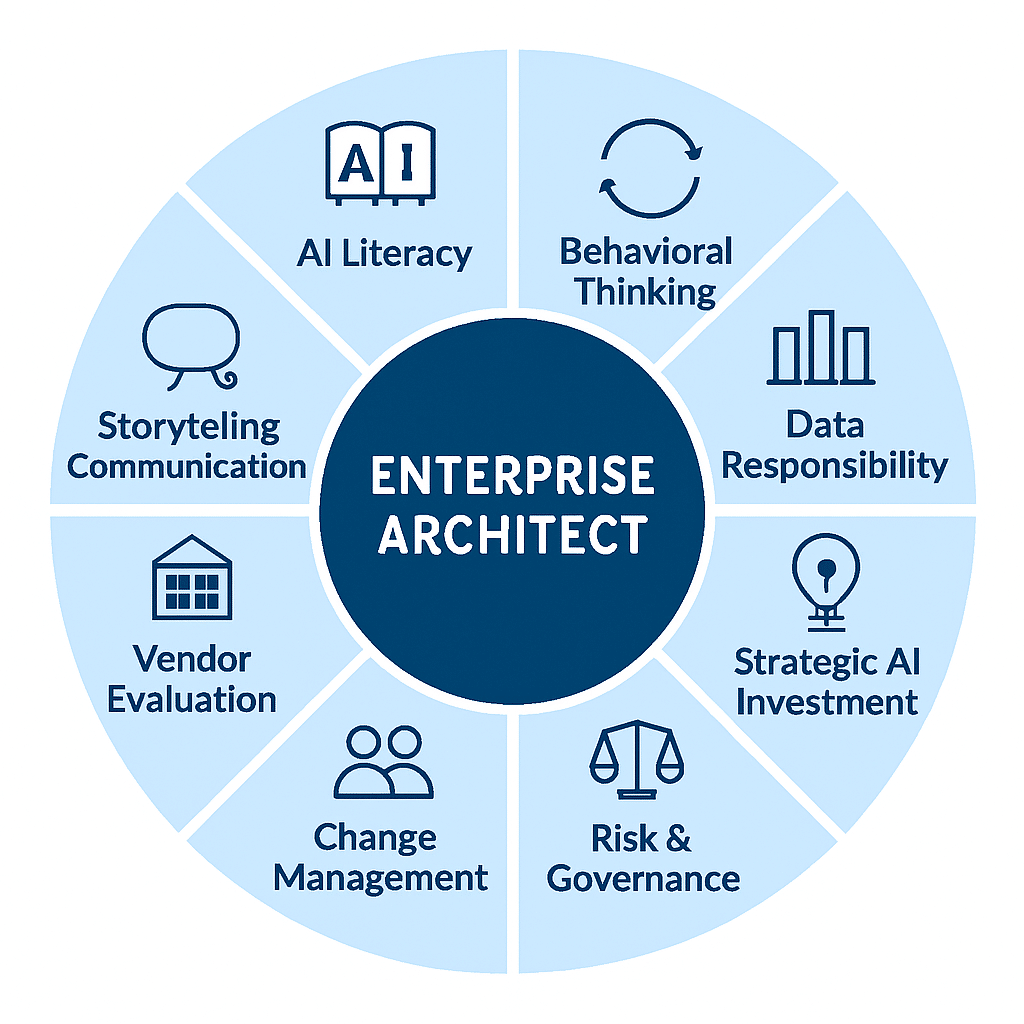
The following table outlines the 8 mentioned skills.
| Skill | Focus | Why It Matters | Practical Takeaway |
|---|---|---|---|
| AI Literacy | Understanding AI concepts & capabilities | Enables informed decisions, bridges tech & business | Stay updated with AI trends; know enough to assess risks/opportunities |
| Behavioral Thinking | Shifting from static structures to dynamic system behavior | Anticipates emergent outcomes & human–AI interactions | Think in loops, feedback, and socio-technical impacts |
| Data Responsibility | Treating data as operational input, not just analytics | Data drives AI outcomes directly | Evaluate bias, fairness, lineage, and trustworthiness |
| Strategic AI Investment | Managing AI initiatives as a portfolio | Prevents fragmentation & wasted resources | Align projects with enterprise strategy; balance innovation vs. stability |
| Risk & Governance | Continuous oversight of evolving AI models | Ensures fairness, compliance, and trust | Embed monitoring & adaptability into architecture |
| Change Management | Preparing people for AI-driven transformation | Builds human–AI harmony & reduces resistance | Define clear roles, reskill, and communicate realistic narratives |
| Vendor Evaluation | Judging long-term fit, ethics, and adaptability | Avoids hype-driven adoption | Assess governance, deployment strategy, and architectural flexibility |
| Storytelling & Communication | Translating AI complexity into business narratives | Builds trust & alignment | Use tailored stories to inspire and clarify AI’s role |
Enterprise Architects stand at the intersection of technology, business, and ethics. In the AI era, their role expands beyond designing systems into shaping trust, guiding adoption, and ensuring resilience.
Together, the skills we explored, from mastering AI literacy and behavioral thinking, to treating data as a living responsibility, structuring AI initiatives through strategic investment management, embedding governance and ethical oversight, leading change management, evaluating vendors, and using storytelling to align stakeholders. These skills position the architect as a bridge between business, technology, and human intelligence.
The future of enterprise architecture will be defined by those who can:
- Unify innovation with responsibility: Balance experimentation with governance to ensure AI strengthens, not undermines, the enterprise.
- Translate complexity into clarity: Use literacy and storytelling to align diverse stakeholders around a shared vision.
- Embed adaptability into culture: Make continuous learning and ethical oversight part of the enterprise identity.
AI is not a passing trend. It is a structural shift in how enterprises operate, decide, and evolve. The architect’s task is to ensure this shift creates lasting value, protects trust, and empowers people. In this way, enterprise architects become not only designers of systems, but guardians of the enterprise’s future.
Let us architect for the future boldly, not for hype, but for enduring value, guiding both humans and AI toward a shared destiny of responsibility and progress.
Share this: